A new article published in Applied Animal Science offers an overview of the impacts of increased droughts on feeder cattle supply, along with potential ways to ensure the long-term sustainability of beef production
Champaign, IL, February 16, 2026—Weather extremes shape every aspect of beef production—from forage availability to animal health to overall profitability. As drought cycles intensify and weather patterns grow more unpredictable across North America, a new Perspective and Commentary article in Applied Animal Science outlines practical strategies beef producers can adopt to strengthen their long‑term resilience. “In many areas of the country, droughts are becoming more severe and lasting longer, which significantly affects forage production and then affects beef cow stocking rates,” said Applied Animal Science editor in chief Bill Weiss, PhD, PAS, Dipl. ACAS. “This Perspective and Commentary article discusses how changes in weather patterns will affect, usually negatively, cow‑calf production and offers management strategies that will help mitigate those effects.”
The article co-authors, Paul A. Beck, PhD, PAS, of the Department of Animal and Food Sciences, Oklahoma State University (Stillwater, OK, USA), and Matthew R. Beck, PhD, PAS, of the Department of Animal Science, Texas A&M University (College Station, TX, USA) synthesized long‑term climate models, historical precipitation data, and recent research to understand future climate trends and the effects of climate disruptions on the industry. “These sources show that North America—and especially the critical Midwest and Great Plains hubs for US beef production—has entered a dry cycle similar to those of the 1930s and 1950s, with more frequent and prolonged droughts,” said Paul Beck. “These conditions have already contributed to significant contractions in cowherd numbers, reduced forage production, and increased production costs for beef operations.”
With less rainfall, producers not only face reduced forage availability but also lower nutritive quality of the forage they do have, both resulting in a myriad of biological consequences for livestock. Nutritional stress and heat stress during pregnancy can influence calf immunity, growth, and long‑term performance of the animal. Cows experiencing declining body condition or heat stress before calving may produce offspring with reduced passive immunity and lower weaning weights. These effects can persist into later life stages. “With reduced forage resources, calves enter the feedlot at younger ages and at lighter body weights, have decreased performance in the feedlot, and have lighter, fatter carcasses at slaughter,” explained Matthew Beck.
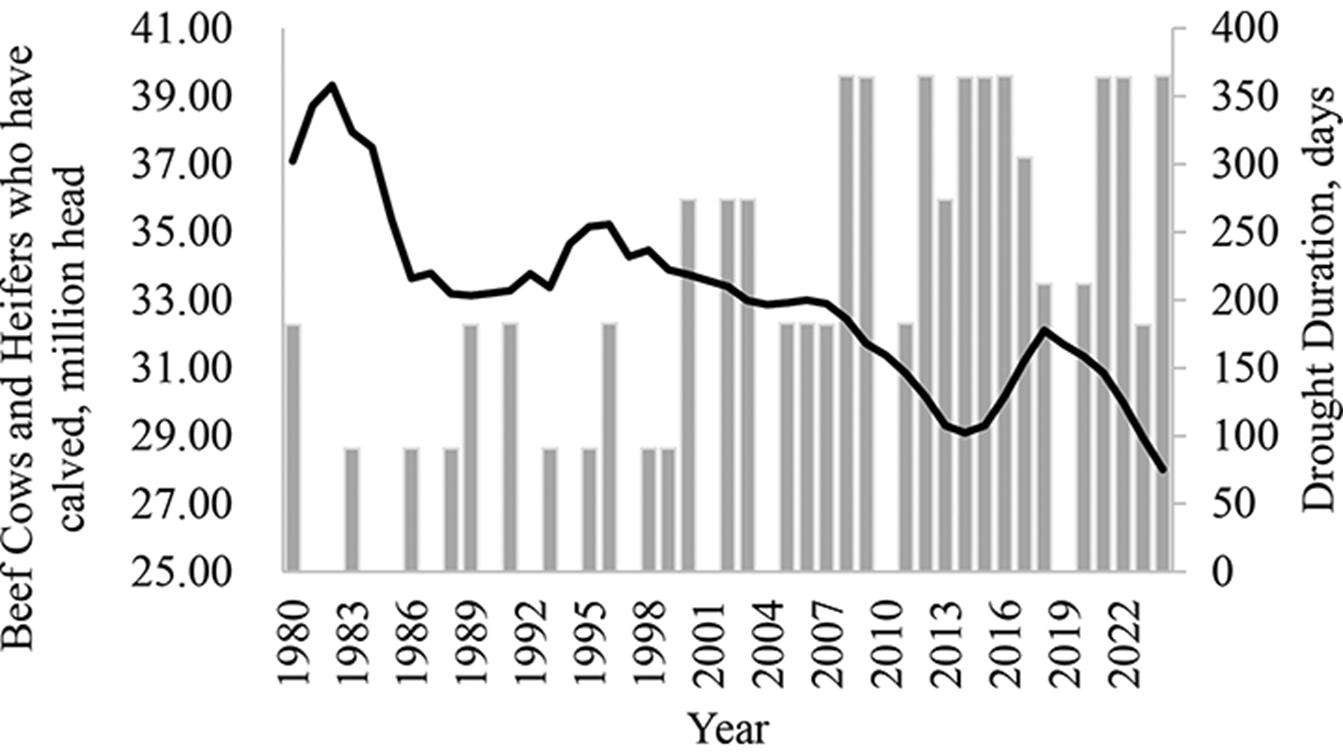
Caption: A new Perspective and Commentary article in Applied Animal Science is initiating a discussion about the impact of climate disturbances on the robustness and resilience of the US beef industry, how these factors affect the feeder cattle supply, potential management strategies to overcome these challenges, and avenues of research to ensure the long-term sustainability of beef production in challenging climate conditions (Credit: Paul Beck and Matthew Beck; data sources: NOAA, 2024, https://www.drought.gov/historical-information?dataset=0&selectedDateUSDM=20250805; USDA, 2025, Cattle, https://www.nass.usda.gov/Publications).
“Our intention was to bring attention to the cascading effects that climate stressors can have on both cows and their calves,” said co-author Paul Beck. “These challenges are real, but producers have tools available to help buffer their operations and maintain productivity even when conditions are difficult.”
Among the strategies discussed in the article are flexible stocking approaches. For stocker operators, that could mean varying the number of head purchased each year and destocking as needed, depending on forage availability. For cow-calf producers looking to build system resilience, it could mean setting their cow herd numbers based on forage production during a poor rainfall year and then retaining or purchasing stockers and replacement heifers to graze in years with more rainfall.
“There are many potential ways ranches can increase the resilience of their cowherds to the challenges raised by the climate upheaval we are experiencing. Forage management strategies, including targeted fertilization, stockpiling of permanent pastures, and integration of complementary annual or perennial forages have the potential to be incorporated with improved grazing management to reduce reliance on often expensive supplemental feed, fertilizer, and fuel,” added Matthew Beck.
The authors note also that mature cow size has increased substantially over the past several decades, raising maintenance requirements and reducing system flexibility during drought years. Research cited in the article suggests that moderate-sized cows may offer advantages in efficiency and resilience, particularly in environments with changing resources.
“Resilience isn’t just about surviving a drought year—it’s about proactively adjusting production practices in order to remain profitable across a wide range of conditions,” said Paul Beck. “Producers who adopt flexible stocking rates, invest in forage systems that can withstand variability, and potentially even select genetics suited to a hotter and drier environment will be better positioned for long‑term success.”
While the article underscores the need for proactive management, it also identifies significant knowledge gaps. More research is needed to understand how climate stressors influence reproductive efficiency, calf health, and carcass quality, as well as to develop tools that help producers make timely decisions in variable environments.
The article appears in the February issue of Applied Animal Science.
Notes for editors
“Perspective and Commentary: Effects of climate change on long-term resilience of beef cattle production and potential management strategies for producers to overcome these challenges,” by Paul A. Beck and Matthew R. Beck (https://doi.org/10.15232/aas.2025-02719), Applied Animal Science, volume 42, issue 1 (February 2026), published by FASS and Elsevier.
This article is openly available at https://doi.org/10.15232/aas.2025-02719.
To schedule an interview with the author(s), please contact Paul A. Beck, PhD, PAS, at paul.beck@okstate.edu or Matthew R. Beck, PhD, PAS, at matthew.beck@ag.tamu.edu.
About Applied Animal Science
Applied Animal Science (AAS) is a gold open access, peer-reviewed scientific journal and the official publication of the American Registry of Professional Animal Scientists (ARPAS). In continuous publication since 1985, AAS is a leading outlet for animal science research and is indexed by Scopus and ESCI (Clarivate’s Emerging Sources Citation Index). The journal welcomes novel manuscripts on applied technology, reviews on the use or application of research-based information on animal agriculture, commentaries on contemporary issues, short communications, and technical notes. Topics that will be considered for publication include (but are not limited to) feed science, farm animal management and production, dairy science, meat science, animal nutrition, reproduction, animal physiology and behavior, disease control and prevention, microbiology, agricultural economics, and environmental issues related to agriculture. Themed special issues also will be considered for publication. www.appliedanimalscience.org
About the American Registry of Professional Animal Scientists (ARPAS)
The American Registry of Professional Animal Scientists (ARPAS) is the organization that provides certification of animal scientists through examination, continuing education, and commitment to a code of ethics. Continual improvement of individual members is catalyzed through publications (including the AAS journal) and by providing information on educational opportunities. ARPAS is affiliated with five professional societies: American Dairy Science Association, American Meat Science Association, American Society of Animal Science, Equine Science Society, and Poultry Science Association. www.arpas.org
About FASS
FASS, the services division of the American Dairy Science Association, provides management services to nonprofit associations and societies with a mutual interest in supporting the advancement of animal agriculture and food systems through research and education. We support nonprofits by providing services for accounting, membership management, convention and meeting planning, information technology, and scientific publishing. The FASS publications department provides journal management, peer-review support, copyediting, composition, and proofreading; the staff includes several BELS-certified (www.bels.org) technical editors and experienced composition staff. www.fass.org
About Elsevier
Elsevier is a global leader in advanced information and decision support. For over a century, we have been helping advance science and healthcare to advance human progress. We support academic and corporate research communities, doctors, nurses, future healthcare professionals and educators across 170 countries in their vital work. We do this by delivering mission-critical insights and innovative solutions that combine trusted, evidence-based scientific and medical content with cutting-edge AI technologies to help impact makers achieve better outcomes. We champion inclusion and sustainability by embedding these values into our products and culture, working with the communities that we serve. The Elsevier Foundation supports research and health partnerships around the world.
Elsevier is part of RELX, a global provider of information-based analytics and decision tools for professional and business customers. For more information, visit www.elsevier.com and follow us on social media @ElsevierConnect.